
What I Kept When I Let Everything Else Go
On finding a simpler way to train — after earning it the hard way

A few more hundred meters until I have to pick up the pace. My heart is pounding like the workout has already started. I can see it on my watch. Slowly creeping up. And I know exactly why.
I’m anxious. Not about the workout itself, but about whether I’ll hit the right numbers. Will I be able to hit the right intensities? Will the data validate that this session “counts”, or will my heart rate not climb where it should climb to?
This was me for a long time. Checking my HR every few seconds. Questioning whether I was going too easy, too hard. Turning what should have been a focused session into a mental negotiation with a number on my wrist.
Looking back, I was overcomplicating something that my body already understood.
The Detour
Here’s the thing: we love complexity. We want to get better, and we want to get there faster. Best, yesterday. So we add layers. We track more. We tweak the plan. We convince ourselves that novelty equals growth.
And when something has been working for a while, there’s this itch. This reappearing voice: I should change something. I’m probably missing something.
So we chase the next protocol. The seemingly smarter approach. The optimisation we haven’t tried yet.
Until one day, training feels heavy. Like you’re managing a system instead of just running.
What Happened When I Let Go
At some point, I stopped chasing heart rate zones and started going by feel. RPE. Rate of perceived exertion. How hard does this actually feel, right now?
It sounds almost too simple. But that’s the point.
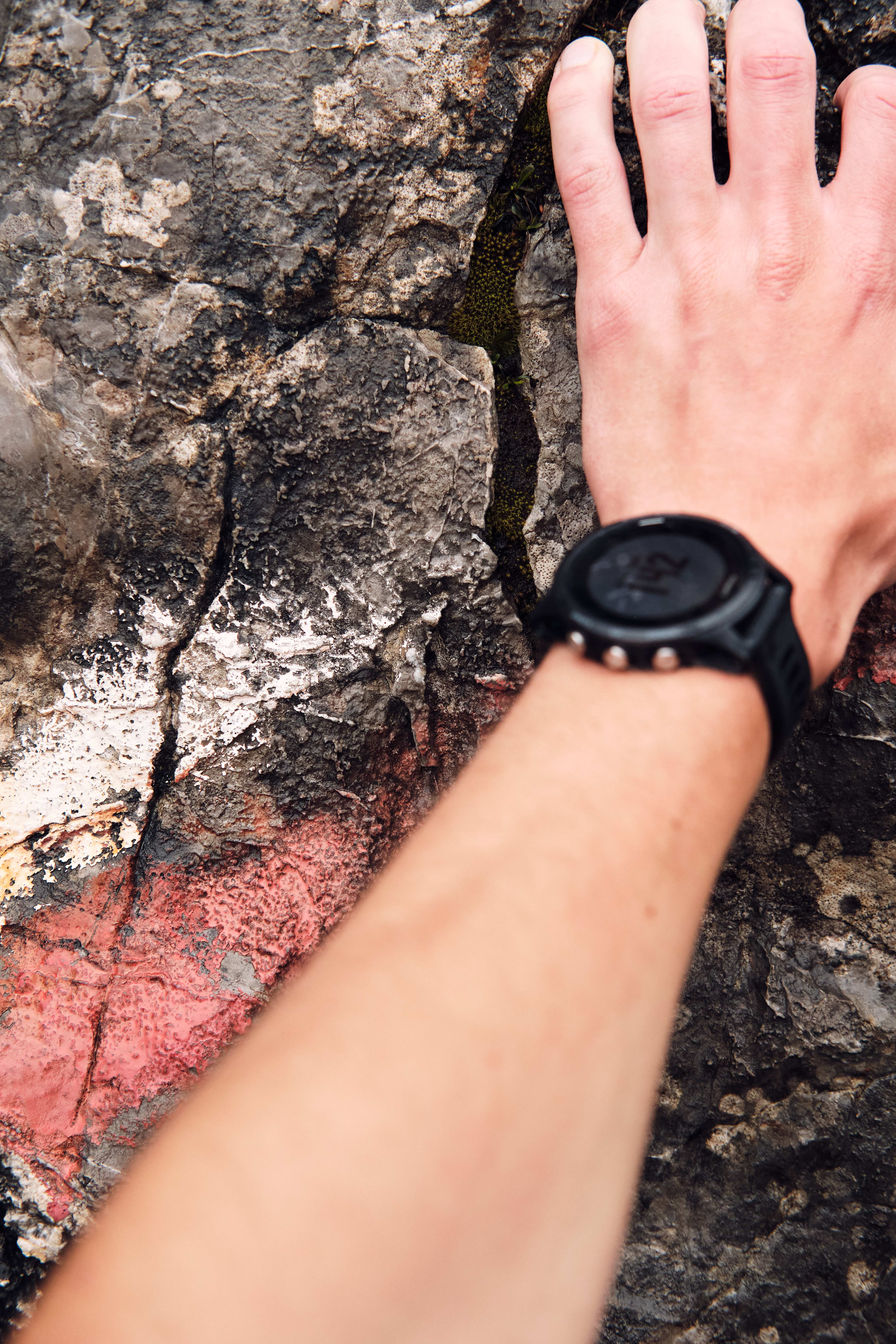
When I let go of the numbers, I felt free. Hard was hard. Easy was easy. I wasn’t fighting my own anxiety anymore. No more self induced stress because I felt like collapsing on the trail but my HR not representing that reality. I just ran hard.
And here’s the thing: when I checked my HR after those sessions, it was often in the same range. Sometimes higher. The body knew. It always knew.
Same effect for less mental effort.
Now, I’m not saying complexity was a mistake. I had to go through all of it: the HR obsession, the overanalysis, the constant tweaking. If I hadn’t, I wouldn’t understand why simplicity works. I wouldn’t trust it.
You can’t skip the homework.

Raising the bar
Here’s what I think about now: raising the bar of your simplicity.
It’s not about going back to zero. It’s about integrating what you learned into something you can actually maintain.
Let me show you what I mean. My training used to look like this: HR zones for every run, specific numbers for intervals, adjustments based on daily readouts, constant watch-checking. It worked, but it was exhausting. I was always managing.
Today, my system is simpler. Easy runs are easy. I don’t check my watch. Hard sessions go by feel: “This should be an 8 out of 10 for these minutes.” Long runs have purpose, but not rigid structure. I know my body well enough now to trust the signals.
That’s it. That’s what years of complexity boiled down to.
But here’s what’s important: this isn’t beginner simple. I couldn’t have started here. My “simple” now contains everything I learned from the complicated phase. The fundamentals are the same, but I understand why they’re the fundamentals. I earned that understanding by wandering through the noise.
A few years ago I wasn’t even able to listen properly to my body and could not have even grasped how a certain intensity should feel. My HR obsession taught me that.
This is what I mean by raising the bar. Your simplicity evolves. It’s not static. You go through complexity, extract what matters, and arrive at a new baseline — something sustainable, something personal.
A professional athlete’s simple looks different from someone juggling a full-time job and kids. That’s fine. The point isn’t to copy anyone’s system. The point is to find your own, after you’ve done the exploration.

The permission you might need
So if you’re deep in complexity right now. Tracking everything, testing new approaches before the old one could even come to fruition, feeling a bit overwhelmed. I want you to know: that’s okay. You’re not doing it wrong. You’re doing the necessary work.
At some point, you just have to start asking yourself: What is all this actually telling me? What can I strip away and still keep the benefit?
You might not have the answer yet. That’s fine. Keep going. The pattern will emerge.
And when you’re ready to simplify, it won’t feel like giving up. You will have learned what truly matters. What the core of it all is.
In the end, easy running is easy running. The method you use to get you there is personal. What counts is that it feels simple to you. That’s it.
Until next time.
What would your training look like if you only kept what actually matters?
Your training story could help.
Switched apps? Left a coach? Changed approach because life got messy? I’m building something for runners like you and want to listen. Would love a chat!
Take for example Scott Johnston. I highly admire him for what he does in the endurance domain but is it the only way to train & wi UTMB? Not at all. Prior winners haven't done this & surely have won in record times on both men and women's side. I listened to every bit of podcast that is available online of Scott Johnston just to pick up his mind. He himself said that it wasn't just because of the specific kind of training, both Ruth & Tom were great athletes before coming to coach under him. There were n number of factors which gets under shadowed or doesn't get seen or emphasized.
No one size fits all. There is no holy grail method or you can say there is no perfect human, no perfect business plan, no perfect education system, no perfect country or state, no perfect parenting principles, no perfect training principles. One needs to do research in any walk of life as we can't we keep doing copy paste in our own lives by seeing what works for other people. But I also feel like I have the approach of open book as well.
I listened to what Tom did for UTMB in the whole race & it seemed this might the most meticulous one has been. He even put his earphones on in the areas he knew the crowd would be quite loud. just to be attuned with his own self and negate the outside noise in order his own body doesn't get over whelmed and his HR doesn't go up which would increase his effort. Just to keep things in control he did this.
Even both Tom Evans & Ruth Croft were more proactive than other elites who were running in the Top-50 on both sides. Ruth learned her lesson from Transvulcania because the weather was horrendous there somewhat similar to UTMB just not snowing but the winds were howling. David Sinclair & Matt Daniels also DNFed because of the weather. Tom told that almost no one was putting the jacket in the lead pack when he had already put up a jacket. He told everyone thought that Francois hasn’t put up a jacket and he is 4 time winner of this race, so better mimic him but Tom did it in his own way. The role of being proactive in ultras is quite an under rated Trait.
On the other side I think so that the coaches who say that muscular endurance training is a waste of time majorly doesn't reflect a lot about training but a lot gets reflected about them as coaches. They say this because- they might not have incorporated this in the training, they are quite narrow minded cognitively to broaden their horizon of training, they want to stick to what worked for them, might be they incorporated muscular endurance training but didn't work out and the they didn't get the expected results from the stimuli. Matthew Richtman even didn't knew about double threshold workouts and even he ran a 2:07:57 in his debut marathon at Los Angeles Marathon in March of this year. And after that he has been dealing with some sort of injury. But it all boils down there is no holy grail method in any particular sport, there are n number of ways to train for any distance in running. One has to be flexible while applying any kind of training, have a gauge how body is responding, what benefits one is getting, what are the risk factors of present training and what tweaks can be made. It's not a copy paste kind of thing meaning as Scott Johnston said apply it in absolute terms, one might not see the results and then they verbally bash Scott that his training method just works for professionals, they won't question themselves are they doing it the right way and are they focusing on other 90% of training that is sleep, nutrition, strength workouts, mobility/conditioning throughout the whole year. Everything compounds one should remember.
I also listened to Rachel Entrekin's podcast & loved the part where she told she is open book. She has been chipping away with consistent progress. It is not an overnight success, she had been competing for almost 12-13 years. On the other side, yesterday I listened to Will Murray on Freetrail and that dude is one heck of a SENSEI. The way he trains- incorporating cycling with running. Some days he cycles for 4-5 hours comes back home and then in 10 minutes transition goes for a run for about whatever his training says for that particular day. And I don't think so anyone has one JJ 100 miler in record time training like this. Everyone who has won has been all running people on men's side.
Right now Taggart Vanetten is preparing for 100 miler at Prairie Spirit Trail on March 28, 2026. Last 11 weeks has been 80 miles(128 KM) running & 200 miles(320 KM cycling) for every week. He has totally changed his way of training as earlier he used to run 150 mile weeks in order to prepare for 100 milers but he has understood no point in this much beating on legs & the whole body in every facet. Cycling helps him build the huge Aerobic Base. He is targeting to dip under 11:19 which is current 100 mile American Record. If this training works for him, then this can be the new modus operandi as earlier it has worked for Will Murray as well.
Adam Lipschitz ran 2:08:54 at Valencia Marathon in 2024 on just 100 KM weeks.
Nothing is concrete- be it belief system, be it any opinion, be it any idea or anything. Getting hooked to any particular thing does no good, life is all about adapting to ever changing dynamics.
Strong opinions loosely held and being open ears to learning & changing our minds on the views we hold onto is the way to propel in life.
It has become a lot difficult in the ever growing content and information market to saturate what is noise and what is the real information. As Daniel Kahneman & Cass Sunstein wrote in the book NOISE- that in how many ways there is flaw in human judgment.
I have been running from June of 2020. This is regarding running but be can be applied to different walks of life as well. Not every moment of life needs to be optimized. Before adding things into our lives, we can look for things that can be subtracted or can be eliminated.
I started running back in June of 2020. I was firstly using a classic Samsung button phone for a couple of months to track just the total time of my runs as I didn't kept a smartphone from 2016 to 2022. Then I bought a Casio watch, not taking my phone on the run to note the total timings of my run. I kept it this way till November of 2024. No smart watch, no strava and no other app to track the metrics. This was also because I didn't intended to keep running for this long. Now I have been using both Coros Pace Pro & Strava since last November. I have been some sort of like Anti Technology and didn't wanted to be tied to all these numbers.
I just wear it on my runs to track my runs and other than that it sits in a drawer. I don't know how many runners are highly attuned with their effort and if they know how do they feel in specific paces while they run.
One is running with earphones listening to music, audiobooks or podcasts. Watch to track and above that HR band around the chest or even the Coros armband for accurate HR tracking. Isn't this on daily basis a lot of information which can impede the feeling one needs to quite aware of in the present moment. It is somewhat solely relying on gadgets. First principles thinking is in quiet scarcity now a days in any walk of life. Everybody wants to copy paste and expect to get the desired results. One can't take the route to peak w/o going to the valleys. In winters, I wear long sleeve and my watch is hidden under it and a lot of the times I try to don't see what HR is or what is the pace I am running. Sometimes it is all about putting in the work and not every minute has to be judged as our brain goes haywire in a very short period of time.
Personally speaking the perception of effort is a major factor. When I say to myself that I have to go on a run for 30 KM at hard effort, my cognition itself knows that this is gonna be quite tough and heartbeat can be felt in head as well. So, it has an idea of what kind of tough it can be but when sometimes I have a 20 KM run or shorter run- it can feel like tough around 12-14 KM mark. Ellen Langer, a renowned psychologist at Harvard did a research and asked people to do jumping jacks and asked when they felt tired, the answer was not a number but two thirds of the way they felt tired. Even if it was asked to do 100, then also around 66 which 2/3 of the way & when asked to do 200- then also 2/3 of the way which is around 135.
It is quite a tough thing make a mark that if smart watches makes runners worse. But I totally understand your point that how it can make an impact on how we perceive things and how it can limit on race day to go the depth of reservoir of pain cave & pushing to nth level. Both Joe Klecker & Biya Simbassa have been running races on sheer determination to do great & not watches let them dictate how they are feeling. Joe Klecker even said no watch or no HR or pace can tell them when to make move. Even Emile Cairess can be seen wearing a simple Casio watch during the marathons and too being Majors where the competitions is cut throat. Nina Engelhard as well trains with no watch & even Zach Miller used to train with a Casio watch, not tracking numbers in first 3-4 years of his running. I still remember Miller vs Hawks youtube video of TNF Endurance Challenge 50 miler in 2016, they weren't relying on numbers- that was sheer end to end battle with grit and not letting their perception of pain getting over them. What happened at CCC which was this year a 60 KM race, I don't think so Jim relied on keeping HR under control sort of thing for 5 hours- he ran as fast as he could for the whole distance. What happened at World Athletics Championship at Tokyo b/w Aphonce Simbu & Amanal Petros.
If you are talking about pain perception and that too in ultras, the example of UTMB 2022. The goat Kilian Jornet was in the trenches and was about to pull the plug from the race but Blanchard came and motivated him to keep moving. Kilian Jornet's perception of pain had surpassed and he himself felt like he emptied the reservoir but it seems even this experienced of an overall athlete misjudged or was taken away by the pain he was feeling at that particular lowest of lows. At the end, Kilian ended up continuing & winning the race in CR time. how is this possible when an athlete was almost about to throw in the towel but ended up winning in CR time. Pain perception is a lot of mental training and not being over whelmed by what one feeling during the lows. And numbers should be a part of training but not should be dictating especially in ultras, everyone has to enter pain cave in ultras. Could Jim have closer to the 100 KM WR times, if he would have kept looking at his watch & HR in 2021 Carbox X2 project, it could have made his cognition go haywire for sure if the numbers would have been a bit off. He missed it by 12 seconds.
Smart watches should play a role and not be over powering over an individual meaning they are just taking every thing on absolute terms which the data is dictating. We need to find a balance to train with watches & Strava as well.
It goes both ways, training is both Easy & Complex. If we are into starting phase meaning we have started any activity we need not focus on zones as our first priority should be- We should have the drive to do it for at least couple of years to see some significant gains in physiology. And yeah at the start every kind of training works as a stimuli, it comes after a couple of months or one can say a couple of years as well when they need to focus on 1% improvement markers. Fundamental is the key meaning putting in the work, nutrition during the workout & for the whole day for months on and recovery in terms of sleep. Sticking to basics does wonders but in this era of information overload & easy access to it, we are focusing firstly to 1% improvement markers rather than 99%.
Joy has to be in the drive seat of training as well. Ben Dhiman after coming 2nd in UTMB simply put one gotta love doing this, then only one can succeed. Tom Evans also said his relationship with running went to that he had to perform & win but before this year's UTMB, he reclaimed his relationship with running which got reflected in his win. Ruth Croft has been having a similar approach for more than a decade. Does Courtney not have fun, when almost 99.99% would have quit, she kept chipping away and continued to cherish the community she was surrounded with.
But even I myself have learned this the hard way, I have read tons of books, listened to almost fifteen thousand podcasts. When I read Scott Fauble & Ben Rosario's book Inside a Marathon, then I got a glimpse of how much of just running people like myself are doing, meaning just running and not training. People want to just run fast in just a couple of weeks or months, but this not how our physiological & muscular adaptations take place. As Kilian Jornet said it takes months and years for your bodies to adapt to the stimuli and our cells and mitochondria to adapt and get the stimulus to get fast and build a huge aerobic base. People don't want to run easy, they just see it on multiple social media platforms and then come to a conclusion I am no where near what people run, I need to run this fast but they need to study multiple coaches from Arthur Lydiard, Renato Canova, Jack Daniels, Joe Vigil, Ed Eyestone, Mike Scannell and others as well.